Tuesday, September 23, 2008

Vinh Long, Mekong Delta, 9/14

After a delicious breakfast at the home stay, we re-boarded our rocking boat for a trip to another floating market. Mr. and Mrs. Muoi bid us farewell.

On the way we passed several boats carrying rice husks to the brick kilns.


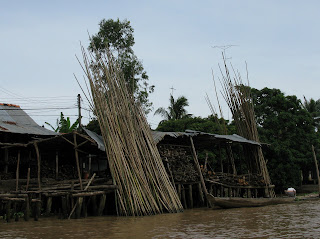
We also went by a bamboo store. They still use bamboo for some scaffolding in construction projects. It is also use for all sorts of other frames and such around houses.

This floating market is in Cai Be, near Vinh Long. It is a different type of market from the one we visited the day before. Here the people come and stay until all of their produce or whatever is sold. Some stay as long as a week. At the previous market the people were local, and usually went home by noon or early afternoon.

And of course there has to be a refreshment boat. Notice the mask the lady is wearing. You will see numerous people wearing them, mostly women, when driving motor bikes to prevent breathing in the dust and other pollutants. I'm not sure why this lady was wearing one, as the air is very clear in the Delta. Even in the cities I have never found it to be offensive. But there is a lot of dust on the roads.

Another thing you will notice in both of the previous pictures is the propellers on a long shaft sticking up in the air. These are the Vietnamese equivalent of an outboard motor. The straight shaft is so they don't need a lower gear box to change the direction from vertical to horizontal. They are powered by Russian engines that make a thump-thump sound when they are running. Smaller boats often use the motor for directional control also, while larger boats usually have a rudder.

Coming into Vinh Long we passed this row of houses. Note the TV antennas. Nearly every house in Vietnam has a TV, no matter how poor. The cities all have cable, but apparently they don't down in the Delta.


We got off our boat to visit some local "factories." On the way we passed this church with children out front having sack races.


The first factory we went to was for making rice paper. It was a true, small factory. Women here work eight hours a day over hot pans making about 2,000 rice paper cakes. For this they receive the equivalent of about $6, which is good wages for Vietnam. The base salary for teachers is about $100 per month. It was so hot inside that it actually felt cool when we went back outside.

As you can see, the workers are used to having tourists traipse through their workplace. Evidently the owner gets some kickback from the tour companies.

Next we went to another shop that made a different type of rice paper, large and thicker than the previous shop.


To the left our local guide is explaining the process. I put "factories" in parenthesis before, as it is clear that most of these shops are set up to demonstrate the process to tourists. They only have one station for each type of work. We also visited candy and rice bar making shops.

Each of these shops had an area where you could sample what they made, and buy it, or other assorted tourist paraphernalia.

We visited an actual sea salt factory before taking our boat back to the bus for our return to HCMC. The sea salt factory used rice husks for fuel, as did some of the stoves in the shops. It isn't clear how many husks might be left for Dr. Ni's logs. The logs do have the advantage that they are easier to transport than the bulk husks.

Labels: , ,

Vinh Long, Mekong Delta, 9/13


After leaving our boat, we had to walk a ways to the bus. Jill picked up a friend on the way.


We bused to Vinh Long where we boarded a different boat. On this one everyone had to stay seated, as it wasn't the most stable vessel. It got us to where we had to go, though.


The first stop was at a brick factory. What was most interesting about it was that they use rice husks to fire the kilns, as you can see to the right. They make bricks part of the year, and ceramic pots and statues when the demand for them is high.


We also passed some fish farms, and stopped at one. In the picture below you can see red snapper in the pen. They also produce catfish. Most of the production is exported to the U.S.

Fish farming has been a very lucrative enterprise in Vietnam. You feed the fish a couple of times a day, harvest them after a few months, and make a bundle. However too many people tried to take advantage, so the sale prices dropped to below profit levels because of overproduction. I read an article a couple of months ago that said they were dumping catfish because they couldn't afford to bring them to market size. The fish farms are also subject to storm damage. A typhoon two years ago wiped out a bid portion of the industry in the Delta.

Our next stop was at the Ba Linh local home. It is run by an elderly gentleman who was once a VC, and his family. Very relaxing and an excellent lunch. It was the student's first introduction to Elephant Ear fish. To the left is what it looked like when it came to the table, and below is what it looked like afterwards.


Across the bridge there was an alligator farm, which looked like it was a tourist place. However, it was fun trying to "catch" the alligators. For a small amount you got a bamboo pole with a piece of meat tied onto the end of a fishing line. Below is Katie, ready to try her luck.

It's easy to catch them, but not so easy to reel them in. I'm glad I'm not the bait.


Once they jump and get hold of it, forget about it. (Pictures in upper right and below courtesy of Josh Strenger; to the right courtesy of Julia Vu)


When we got back to the lunch house, it started pouring, as it is quite prone to doing here.


Michael sacrificed himself to help everyone back on board in the rain.

Next we went to one of the tourist meccas of the Delta, a banzai garden where you are served tea and fruit, then allowed to hold a python. Boats go in and out constantly, and the place is packed with western tourists. Some of the same groups we saw here, we ran into at some of the stops the next day.


The gardens were pretty, and you did get to hold an 80 lb python.


Next we took a 20 minute sampan ride to get back to our boat. Why is the lady rowing while Jared, Andrew, Michael, and Tom hang out?


Our boat then took us to Mr. Muoi's house for our overnight home stay. It was a very relaxing evening, and the students enjoyed it very much.


There were women's and men's bunk rooms. For many if the students it was the first time they slept under a mosquito net. The mosquitoes actually weren't bad, but the netting protected you while you slept.


Here Diana and Phat are talking on the porch.


The students go to help make spring rolls before dinner. They were delicious.


A good deal of card playing went on.


The food was delicious. Some students said it was the best they have had.


There was after dinner entertainment provided by local musicians, augmented by our own talent.


Labels: , ,

Monday, September 22, 2008

Mekong Delta, Can Tho, 9/11 - 9/13

(9/11) After an afternoon briefing and lecture on the changing class system in Vietnam, we departed for Can Tho, deep in the Mekong Delta. Our trip included a stop for dinner at the Vietnamese equivalent of a rest stop, and a ferry crossing of the west branch of the Mekong.


On Friday morning, our first stop was at the Hoa An Research Center. Dr. Ni gave us a good briefing on the goals and projects of the center. Here is is showing us artificial logs for burning made out of rice husks. To the right you can see baskets of shredded water hyacinths, which they are composting and using for raising earth worms. They are also making enough methane from pig waste to power the center. When the pigs are big enough, they are sold to help support the center. The center works with local farmers to promote organic crop production. It remains to be seen if many of the ideas will be adopted by the agricultural industry of Vietnam, as the center is not government supported, and there are other uses for some of the raw materials. Water hyacinths are dried and used to make baskets, and rice husks are used as a fuel in other industries, as you will see later.

The picture to the left shows another good project undertaken by the center. Much of this area was defoliated and bombed during the American conflict. Here you see a stand of Eucalyptus used as an initial cover for damaged land. Later other trees and plants will be added to rejuvenate the biodiversity of the forest.

We had lunch at the center, then bussed back to Can Tho (about an hour) for a walking tour of the city.

We visited two Buddhist temples on the way. The first was a Chinese temple, and had this interesting statue of Buddha in the entrance that is used as a donation receptacle. Notice the hole where his belly button should be.

The second was a Khmer temple, which showed a marked Cambodian influence. Our guide took a group picture of us on the top steps. The tour ended up at the downtown supermarket, which is the biggest I have seen in Vietnam, and very westernized. I thought it was a strange place to finish up, but the students thought it was great, and several did some shopping.


Early Saturday morning we boarded boats to visit the floating market in Cai Rang, the largest in the Delta.


Below is a picture of our CET assistant in Ho Chi Minh City, Phat, taken in route to the market. He did an excellent job for us for the three weeks of our stay there, and will meet us in Hanoi for a few days to brief the new CET assistant up there, Ngoc.

Since so much of the transportation in the Delta is by boat on the canals and waterways, it makes prefect sense that they would have a floating market place. Once we got to the market, there were all sorts of vendors, including small boats acting as convenience stores for the market boats, or refreshment stands for the tourists. Children are often used to entice the tourists, but the adults pedal to the locals.

Boats are often rafted together, and a sample of the goods available is hung on the staff to let others know. Many of the families live on the boats, thus you see kids and dogs running around, as well as the occasional rooster, and clothes drying on the back.

The picture below gives you some idea of how big the market was. It went back probably 30 boat depths.


Some of the local vendors used much smaller boats.


The front of our boat was a good place to take pictures from, and a good place to get pictures taken of you!


After a thorough tour of the market, we returned to the north side of the river where we met our bus. It had already crossed on the ferry.
My next posting will discuss the rest of our Mekong Delta trip.

Labels: , ,